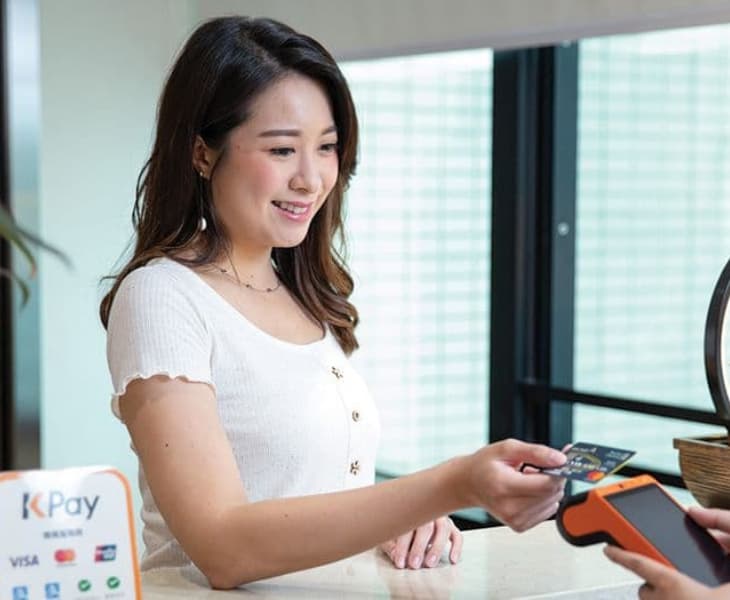
With the increasing popularity of electronic payment, we no longer need to rely on cash for transactions. Many merchants and online shops have started to accept e-payment, including electronic wallet and credit cards, etc. Customers can choose the payment methods they prefer. However, which one is more suitable for you among all of them? What are the advantages and disadvantages of different payment methods? Which one has lower time and money cost? Below is a detailed breakdown for you!
Business Tips
Best Payment Methods for Online Stores in Hong Kong

1 December 2025

12 min read


KPay Editorial Team

Common Third-party Payment Gateways that Support Credit Card Payment
- Bank card type: Visa / Mastercard / JCB
- Online transaction fee: From 1.9% + HK$1
- Online payment method: Share Payment Link
Paypal
- Bank card type: Visa / Mastercard / American Express / Discover
- Online handling fee: 3.9% + HK$2.35
- Online payment method: Share Payment Link / API integration with checkout page
Stripe
- Bank card type: Visa / Mastercard / American Express / Maestro / UnionPay / JCB / Discover
- Online Handling Fee: 3.4% + HK$2.35
- Online payment Method: Sharing Payment Link / API integration with checkout page
Advantages:
- Credit card is a mainstream electronic payment method, merchants can grasp more business opportunities.
- They are convenient for customers to make payment online anytime, anywhere, and increases the desire to shop.
- Customers can also enjoy the benefits of using credit cards, such as earning cash rebates, bonus points or miles, etc.
- They generally support multi-currency transactions.
- Some third-party payment platforms not only support credit cards, but also a variety of debit cards and mobile wallets, making it more flexible to receive payments.
Disadvantages:
- Merchants are required to pay a transaction fee.
- Some third-party payment platforms charge an account opening fee and an annual fee.
- Younger customers or customers without stable income may not have credit cards.

PayMe for Business
PayMe for Business allows merchants to receive payments from all PayMe users via their mobile devices, with no limit on the amount of money they can collect. As long as you are an HSBC Business Internet Banking customer, you can register and use PayMe for Business. Merchants can receive payments from their customers via PayCode in the mobile app, while customers can make payments by scanning the merchant's PayCode with their personal PayMe. Merchants can also send the PayLink payment link to their customers via WhatsApp, SMS or email.
Online payment method:
- Share mobile phone number, PayCode, PayLink / API integration with checkout page
Online transaction fee:
- 1.2% to 1.5%
Advantages:
- Merchants only need to provide a phone number, PayCode or PayLink to receive payments.
- Funds are deposited directly into the bank after receiving payment and no additional fee is required.
- Merchants can refund customers instantly via PayMe for Business.
- There is no minimum or maximum transfer amount.
Disadvantages:
- Merchants are required to open an HSBC Business Internet Banking account and pay a one-time account opening fee, which is approximately HK$1600.
- Merchants are required to pay a transaction fee
AlipayHK / WeChat Pay HK
AlipayHK and WeChat Pay HK are extensions of Mainland China's payment platforms "Alipay" and "WeChat Pay". The payment method is simple: customers just need to scan the QR Code of the merchant. In addition to receiving and transferring funds in Hong Kong, you can also remit funds to your bank account in Mainland China from both Hong Kong and the mainland.
Online payment method:
- Sharing Payment Code / API integration with checkout page
Online transaction fee:
- AlipayHK: 0.8 - 2.5%
- WeChat Pay HK: Enquiry is necessary.
Advantages:
- They support various top-up methods, such as convenience store top up, which is convenient for customers who do not have a credit card.
- They support direct remittance to Mainland bank accounts.
Disadvantages:
- Merchants may need to pay a transaction fee.
- There are transaction and transfer limits.

Octopus App for Business
Merchants can simply download the Octopus App for Business and open an account; online customers can then pay by scanning the QR code.
Online Payment Method:
- Sharing Payment Link / API integration with checkout page
Online Handling Fee:
- 1.5% (via Octopus App payment link)
Advantages:
- It has a massive user base, with up to 95% of Hong Kong people using Octopus.
- Payment can be made easily through the Octopus mobile app.
Disadvantages:
- Merchants are required to provide a Business Registration for application.
- Merchants are required to pay a transaction fee.
Tap & Go
Tap & Go is an electronic wallet for Mastercard and UnionPay cards. It covers over 100,000 physical and online merchants in Hong Kong. In addition to QR Code scanning, it also supports payment methods such as Apple Pay, Google Pay, FPS and UnionPay Quickpass App
Online payment method:
- Invoicing API Interface Function
Online transaction fee:
- 1.3%
Advantages:
- It supports various major online shop platforms, such as Boutir, Mshop App, posify, SHOPAGE and ypShop.
Disadvantages:
- Tap & Go merchants may need to pay monthly service fee, platform fee, etc.
- It has a lower penetration rate compared to other electronic wallets.
Register online to get KPay's Payment Link for your online store or talk to our sales team to find out more today.
Important Notes
Bank transfer (ATM money transfer)
Bank transfers can be divided into ATM transfers and Faster Payment System (FPS). The former is a more traditional method of receiving money. You can go to the ATM of your own bank and make a free transfer to the same bank or other designated banks. It usually takes only 1-2 working days for the transfer to be successful.
Online transaction fee: There is no fee for transferring funds between your bank or designated banks.
Advantages:
- There is no transaction fee for both customers and merchants.
- The most traditional payment method, suitable for people who do not have e-payment tools and the elderly.
Disadvantages:
- It is inconvenient with high time cost
- Customers' desire to buy may drop easily and they may easily abandon the order.
- Merchants have to check each of their orders and transfer receipts by themselves, which is more prone to manual mistakes.
FPS
Faster Payment Service (FPS) is a fast payment system launched by the Hong Kong Monetary Authority (HKMA) that allows you to make payments as quickly as you know the mobile phone number, email, FPS Proxy ID or QR code of the payee. FPS supports 22 banks and 11 electronic payment gateway operators, and you can receive payment at any time regardless of bank opening hours.
Online transaction fee:
- Personal account: There is no transaction fee.
- Business account: Some banks require a transaction fee.
- DBS Bank: Free for the first 50 transactions below HK$1,000,000, and HK$5 per transaction thereafter.
- HSBC: 0.6% transaction fee per transaction; suitable for micro-enterprise.
Advantages:
- Users can receive money anytime, anywhere.
- Users can receive payment by mobile phone number, email or FPS ID.
- It supports cross-bank payments and payments made from other POS platforms.
- It supports currencies other than Hong Kong Dollar, e.g. RMB.
Disadvantages:
- Some banks have a daily transfer limit (around HK$10,000), which prevents you from making large-amount transactions.
- To use FPS for Business, users may be required to apply for a commercial bank account and pay transaction fees.
Credit cards
Credit cards generally refer to Visa, Mastercard, American Express, etc. Merchants can accept credit card payments through different third-party payment gateways, such as KPay Payment Link, Stripe, PayPal, Shopline Payment, etc. Some third-party platforms also support both online and offline payments, making it convenient for both online and physical shops to use them at the same time. Take KPay as an example, its online Payment Link and offline smart POS terminal both accept credit card payments, allowing merchants to manage all transaction records in one account. Even if you don't have an online shop, you can still collect payment instantly through the online Payment Link, which enhances the flexibility of transactions and allows you to collect payments online and offline without any boundaries.